


Try 3 complimentary assessments- on us!
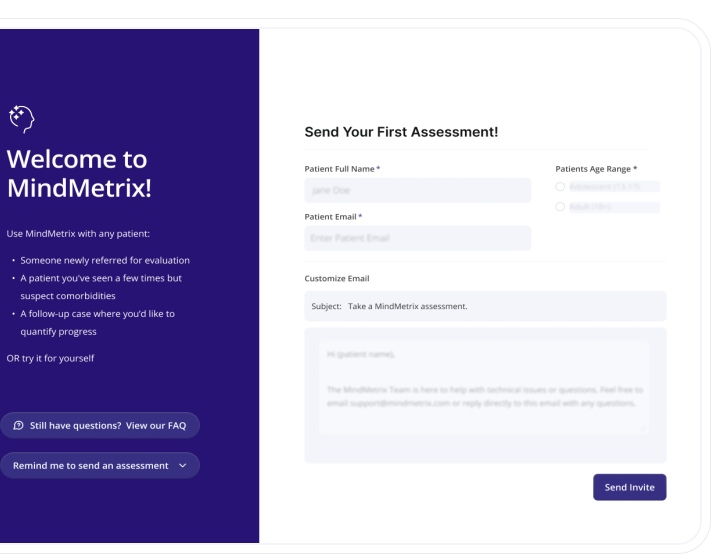
Create an account to send an assessment link to your patient(s). Get results on 60 conditions before your next visit.
Start with the patient who needs more clarity.
Most patients can benefit from a stronger diagnostic baseline, but for your first MindMetrix assessment, think about someone on your schedule today:
- A new referral or evaluation
- A patient with symptoms that do not fit neatly into one diagnosis
- Someone you suspect may have comorbidities
-
A patient who is not improving as expected
-
A follow-up case where you want to measure progress more clearly


How it works
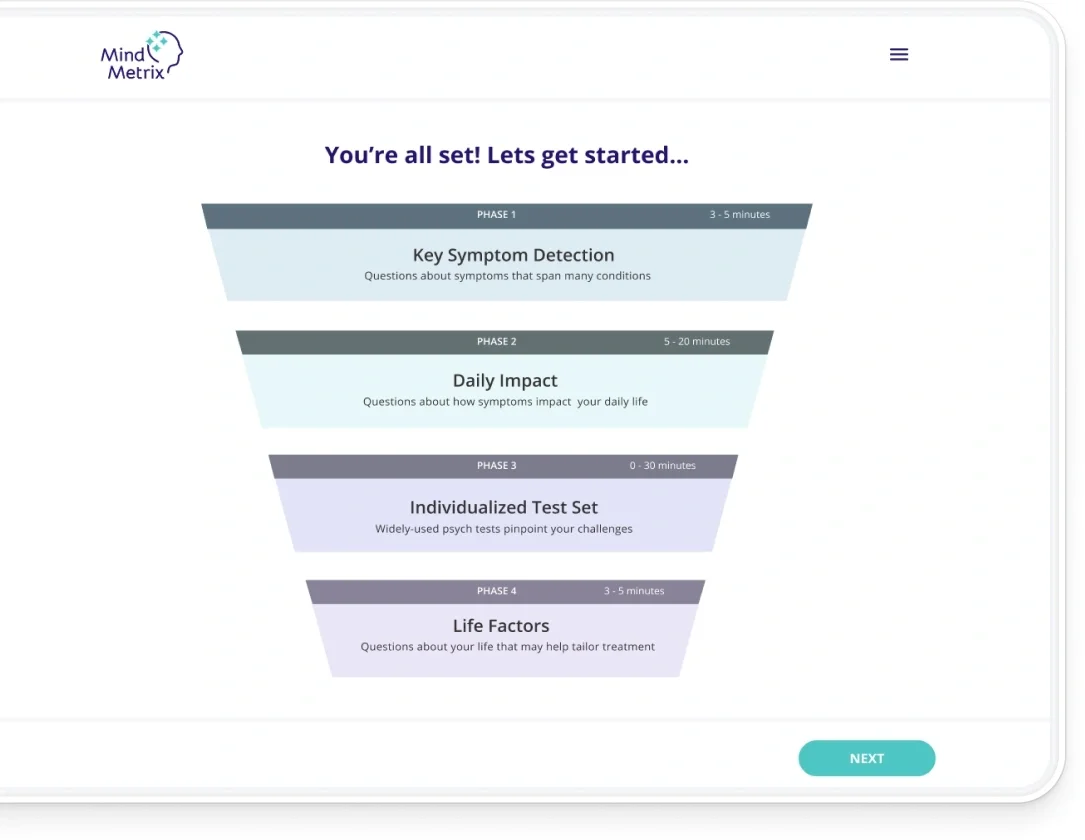
Provide data-backed care in minutes, not months

MindMetrix in practice
MindMetrix can be implemented across diverse clinical workflows and settings. Learn more here.
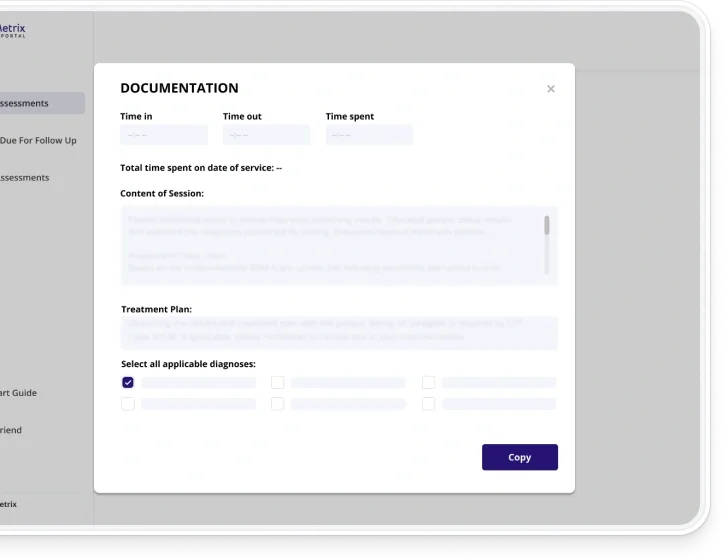
- Assessments can be billed by Physicians (MD, DO), Mid-level providers (NPs, PAs)
- Must reflect ≥31 minutes of clinical work
- Typically billed in addition to an E/M code when both are necessary (with modifier 59)
FAQs
We’re committed to being clear and straightforward
If you’re a prescriber, and spend 31 minutes or more (including prep time) reviewing MindMetrix results with a patient, you're likely eligible to bill CPT code 96130 in addition to your Evaluation & Management visit code. The amount and coverage depends on payor and your specific contracts. Practices should confirm with their billing team and ensure documentation meets all internal and payer-specific requirements. MindMetrix cannot guarantee reimbursement outcomes. Providers and practices are solely responsible for how they code, bill, and document. Check out our blog for more information on this code.
MindMetrix calculates post-test probabilities based on patient responses to validated psychiatric rating scales. The algorithm weighs symptom patterns and severity to generate a probability score for over 60 DSM-5 conditions. These probabilities are not diagnoses: they’re designed to support clinical decision-making by identifying which conditions may warrant closer evaluation.
Yes. Clinicians use MindMetrix both at intake to inform diagnosis and treatment planning, and periodically during care to monitor symptom progression or treatment response. The platform supports longitudinal tracking of patient symptoms over time through our Follow-Up Testing feature, which we recommend administering every 6-12 months.
On average, the full assessment takes around 30-60 minutes to complete. Completion time tends to vary based on patient age and the breadth of symptoms they are experiencing. Patients can take breaks at any point and return to the assessment where they left off.
The adult version requires approximately a 7th-grade reading level, while the adolescent version is written at about a 5th-grade level.

Want to give it a try? Just create an account.
We’ll get you set up with 3 free tests for your patients
Get a sample report
Sign up for our newsletter and receive a sample report. Plus be the first to know about our new releases and insights.