A single tool for cross-cutting mental health assessment.
Covers 60+ conditions across adolescent and adult populations, without sacrificing clarity or depth. Our adaptive technology screens broadly, then narrows to curated, condition-specific rating scales for focused clinical insight.

The Assessment Process
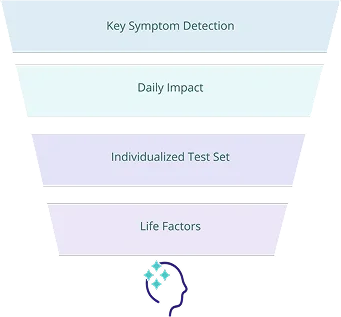
The Four Phases of a MindMetrix Assessment
The MindMetrix Assessment is designed to supplement and strengthen a clinician’s initial evaluation – not replace it. It brings a level of structure, breadth, and psychometric rigor that is difficult to achieve in a standard visit, giving providers a clearer picture of symptom patterns, comorbidities, functional impact, and contributing factors. It begins with a broad symptom screen and adapts in real time, guiding each patient through validated rating scales and targeted context questions. Scales included in MindMetrix are chosen for demonstrated psychometric integrity: specifically high sensitivity, specificity, and reliability, supporting clinically meaningful interpretation of symptom alignment.
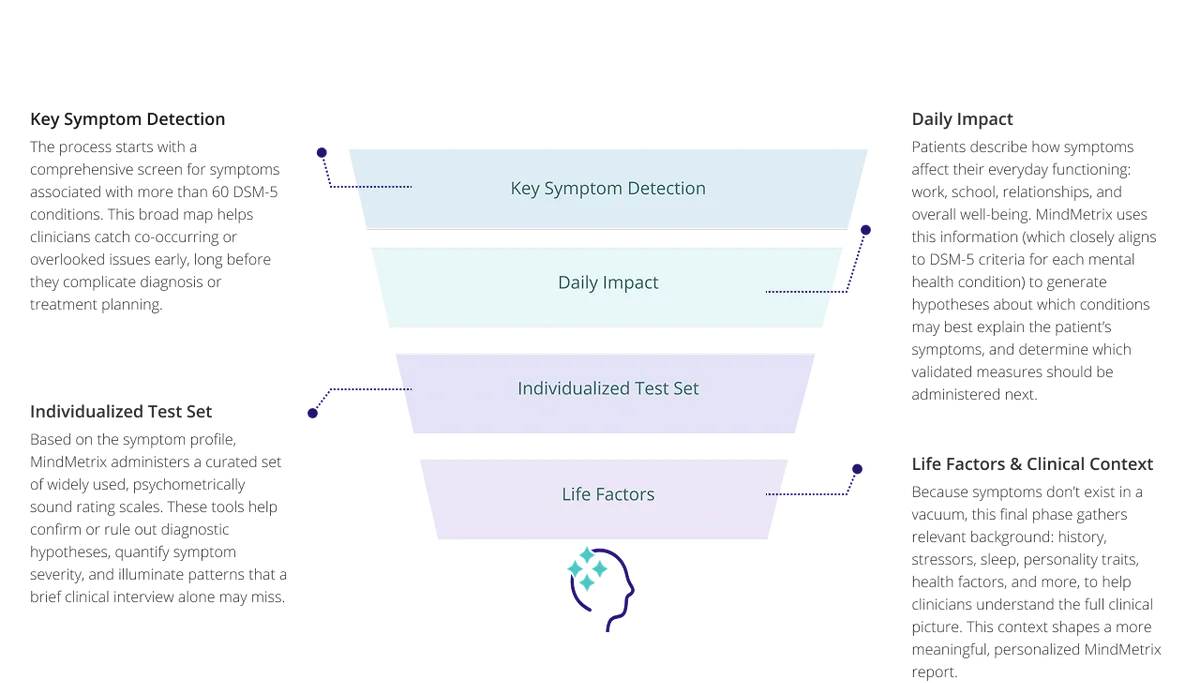
Key Symptom Detection
The process starts with a comprehensive screen for symptoms associated with more than 60 DSM-5 conditions. This broad map helps clinicians catch co-occurring or overlooked issues early, long before they complicate diagnosis or treatment planning.
Daily Impact
Patients describe how symptoms affect their everyday functioning: work, school, relationships, and overall well-being. MindMetrix uses this information (which closely aligns to DSM-5 criteria for each mental health condition) to generate hypotheses about which conditions may best explain the patient’s symptoms, and determine which validated measures should be administered next.
Individualized Test Set
Based on the symptom profile, MindMetrix administers a curated set of widely used, psychometrically sound rating scales. These tools help confirm or rule out diagnostic hypotheses, quantify symptom severity, and illuminate patterns that a brief clinical interview alone may miss.
Life Factors & Clinical Context
Because symptoms don’t exist in a vacuum, this final phase gathers relevant background: history, stressors, sleep, personality traits, health factors, and more, to help clinicians understand the full clinical picture. This context shapes a more meaningful, personalized MindMetrix report.
Flexible pacing that meets patients where they are
Test-takers can pause, resume, and complete the assessment on their own time, on any device


Screen broadly. Go deeper where it counts...
MindMetrix screens across a wide range of prevalent and often overlooked conditions, then adapts in real time to deliver condition-specific, validated assessments, capturing the full clinical picture.
Anxiety
- Agoraphobia
- Generalized Anxiety Disorder
- Panic Disorder
- Separation Anxiety Disorder
- Social Anxiety Disorder (Social Phobia)
Compulsive
- Body Dysmorphic Disorder
- Hoarding Disorder
- Obsessive-Compulsive Disorder
Developmental
- Attention-Deficit/Hyperactivity Disorder
- Autism Spectrum Disorder
Eating
- Anorexia Nervosa
- Binge-Eating Disorder
- Bulimia Nervosa
- Other Unspecified Feeding or Eating Disorder (UFED)
Mood
- Bipolar I Disorder
- Bipolar II Disorder
- Cyclothymic Disorder
- Major Depressive Disorder
- Major Depressive Disorder with peripartum onset
- Persistent Depressive Disorder (Dysthymia)
Other
- Gender Dysphoria
- Psychosis
- Psychotic Symptoms
- Suicidal Ideation & Behavior
Personality
- Borderline Personality Traits
- Antagonism
- Detachment
- Negative affect
- Disinhibition
- Psychoticism
Sleep & Fatigue
- Chronic Fatigue Syndrome
- Insomnia Disorder
- Narcolepsy
- Restless Legs Syndrome (Coming soon)
Somatic
- Somatic Symptom Disorder
Stressor-related
- Acute Stress Disorder
- Adjustment Disorder
- Posttraumatic Stress Disorder
Substance
- Alcohol Use Disorder
- Substance Use Disorders
- Cannabis Use Disorder
- Gambling Disorder
Conduct-related
- Conduct Disorder
- Oppositional Defiant Disorder (ODD)
Learn how others live with and treat each condition.
The MindMetrix Condition Guides were written and edited by our team of experts.
Grounded in Clinical Science
MindMetrix combines validated psychometrics with probability modeling to place symptom patterns in clinical context. Elevated Likelihood scores express how a patient’s presentation compares to population norms - supporting careful, data-informed clinical judgment.

Reducing Common Self-Report Biases
Self-report is essential for understanding lived experience, but it has limits. MindMetrix reduces error through:
Multiple measures per condition
Uses several validated scales rather than relying on a single questionnaire.
Quality checks within ADHD assessments
Includes built-in tools that strengthen the accuracy of ADHD-related results.
Weighted scoring based on test accuracy
Interprets each result using the known (published) precision of the instrument.
Concealed test identities
Scales are unlabeled during the assessment to support natural, unbiased responses.
Cross-scale pattern checking
Looks for consistency across symptom, history, and impairment measures.
Randomized scale order
Presents scales in varied order to reduce patterned responding and survey fatigue.
Validated Measures, Used Intelligently
MindMetrix intelligently administers over 80 peer-reviewed rating scales, selected for their sensitivity, specificity, and clinical relevance. Rather than relying on a single measure per condition, each test set combines scales that capture symptoms, history, and functional impact from complementary perspectives. This approach allows clinicians to see not just whether symptoms are present, but how they show up, resulting in a more complete and nuanced clinical picture.

Our latest insights
Rooted in scientific research, MindMetrix is committed to furthering our understanding of the human condition.to-date with the latest from MindMetrix.

How Comprehensive Screening Impacts Patient Experience
Learn about what patients care about when it comes to getting a proper diagnosis.
View Article
Preventing ADHD Under- and Over-Diagnosis
Learn the factors that can help improve the accuracy of ADHD diagnoses.
View Article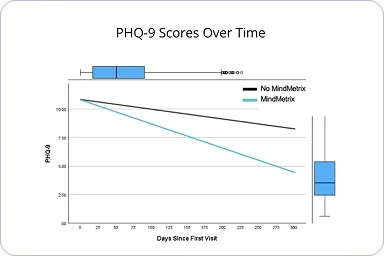
MindMetrix Outcomes Study
Comprehensive mental health assessment with MindMetrix is associated with improved patient outcomes.
View StudyClinical Role & Appropriate Use
MindMetrix is designed to inform clinical decision-making, not replace it. Our assessment highlights patterns of symptoms, functional impact, and contributing factors - giving providers a clearer foundation for evaluation and treatment planning.
While MindMetrix uses validated tools and probability-based modeling, it is not a diagnostic instrument and does not provide treatment. Only a licensed healthcare professional can diagnose a psychiatric condition or determine medical necessity.
What MindMetrix can do is identify areas of potential concern with a high degree of confidence, organize the information patients share, and help guide next steps, equipping individuals and their clinicians with a clearer path forward.
Get a sample report
Sign up for our newsletter and receive a sample report. Plus be the first to know about our new releases and insights.