Cognitive Fatigue in ADHD: Symptom Domain Contributions in a Clinical Sample
Presented at NEI Spring 2026
Authors: Ze’ev Lailari, Joel L. Young, R. N. Powell, Anna Powell, Lisa L. M. Welling, Lauren Granata, Jaime Saal, Margot Nash
Affiliations: MindMetrix, LLC; Rochester Center for Behavioral Medicine; MedaData, LLC; School of Medicine, Wayne State University; Department of Psychology, Oakland University
Aim
Characterize the domains of ADHD associated with clinically significant, medically unexplained cognitive fatigue.
Background
Chronic fatigue syndrome (CFS) affects 1–2.8% of the general population in the United States, and although its etiology is unknown, alterations in central nervous system pathways and chronic stress are cited risk factors.
Adults with ADHD expend a heightened level of cognitive demand to attend to responsibilities and maintain conventional functioning while coping with ADHD symptoms; patients with CFS and/or ADHD may experience cognitive dysfunction as a result of stress or increased cognitive load.
ADHD is highly comorbid with anxiety, depressive, and sleep disorders, also contributing to risk of elevated fatigue.
Given the relationships between ADHD, comorbid psychiatric conditions, and precipitating factors of CFS, particularly cognition, this study investigated relationships between mental health domains and cognitive fatigue, as well as differences in cognitive and physical fatigue symptoms depending on ADHD diagnosis.
Methods
Study Design
Retrospective analysis of electronic health records of patients.
Procedures
Patients were referred to complete a comprehensive, dynamic, digital mental health assessment (MindMetrix) by their clinician.
The assessment may be completed on a personal computer, and there is no time limit.
Data were retrieved from the secure, HIPAA-compliant centralized data storage, including assessment results of patients from over 60 psychiatric practices in the United States.
MindMetrix results from a total of 856 assessments with follow-up diagnostic data were included in the analysis
Comprehensive Assessment
In the two-phase digital assessment, patients indicated whether each of a list of key symptoms of a broad range of more than 60 psychiatric disorders describe symptoms they may have experienced at some point in their life and its daily impact.
Key symptoms and daily impact items that met predetermined gating thresholds triggered distribution of disorder-specific follow-up test sets, each of which consist of up to three validated self-report assessment scales.
Assessment Scales Distributed in the Comprehensive Assessment Included in the Analyses
ADHD
- ADHD Symptom and Side Effect Tracking (ASSET)
- Wender Utah Rating Scale (WURS)
- Adult ADHD Self-Report Scale (ASRS)
Depression
- Patient Health Questionnaire-9 (PHQ-9)
- Center for Epidemiologic Studies Depression (CES-D)
- Quick Inventory of Depressive Symptomatology–Self-Report (QIDS-SR)
Anxiety
- Generalized Anxiety Disorder-7 (GAD-7)
- Hospital Anxiety and Depression Scale-Anxiety (HADS-A)
- Screen for Adult Anxiety Related Disorders (SCAARED)
Insomnia
- Insomnia Severity Index (ISI)
- Athens Insomnia Scale (AIS)
Cognitive Fatigue
- Myalgic Encephalomyelitis/CFS Fatigue Types Questionnaire Brain Fog (MFTQ-BF)
- Myalgic Encephalomyelitis/CFS Fatigue Types Questionnaire Post-Exertional Fatigue (MFTQ-PE)
Statistical Analysis
Composite factor scores were derived from principal component analyses conducted separately within symptom domains.
The relationship between symptom severity across these distinct domains and cognitive fatigue (MFTQ-BF) were evaluated with linear regression.
ANOVA tested whether ADHD diagnosis affected average scores on the MFTQ-BF and the MFTQ Post-Exertional Fatigue (MFTQ-PE) subscales.
Results
Figure 1: Relationship Between ADHD Severity and Cognitive Fatigue
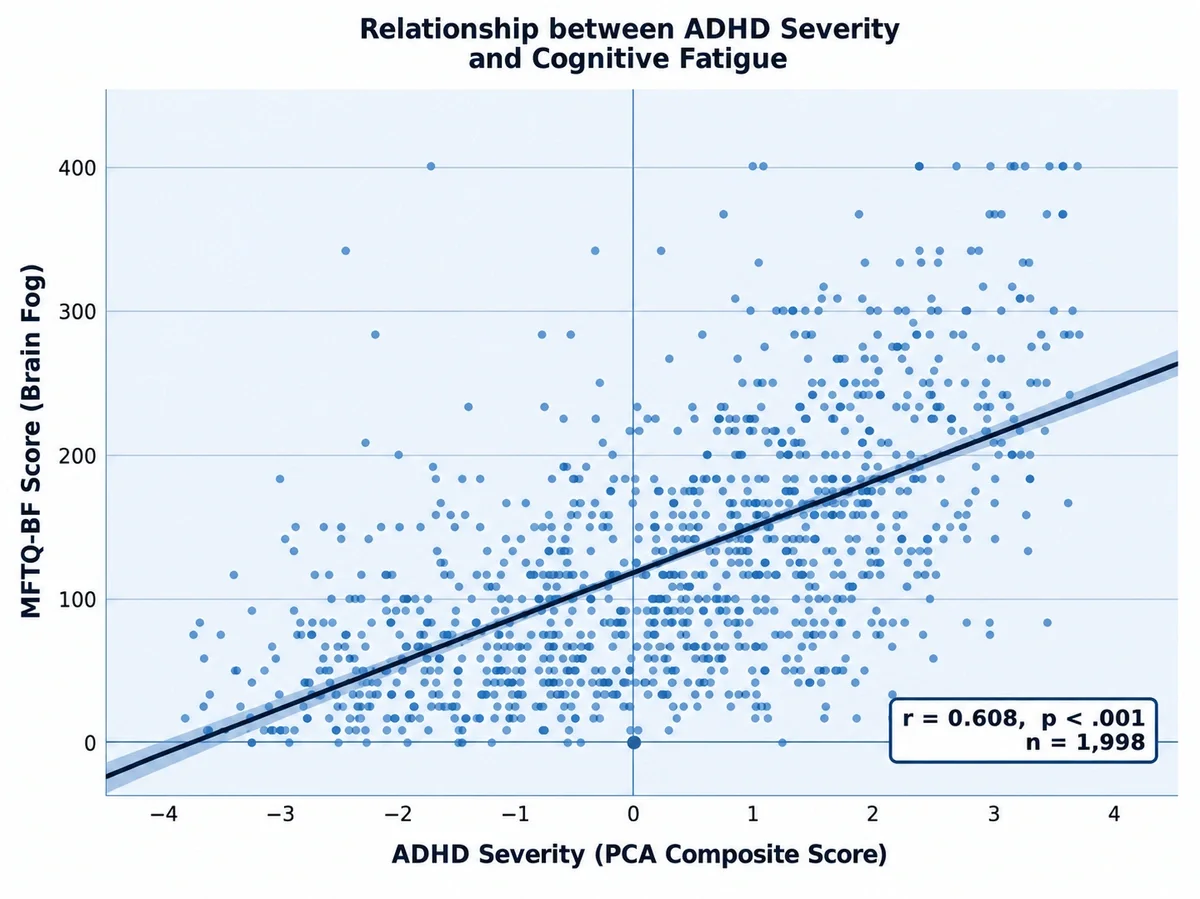
Linear regression demonstrated a significant effect of ADHD severity on MFTQ-BF, independent of variance explained by anxiety, depression, and insomnia (F (4) = 194.29, p < 0.001).
ADHD was the strongest driver of MFTQ-BF scores compared to depression, anxiety, and insomnia (β = .536, p < 0.001).
The figure highlights that as ADHD symptom severity increases, reported cognitive fatigue increases as well, even when accounting for other psychiatric symptom domains.
Figure 2: Cognitive vs Post-Exertional Fatigue by ADHD Status
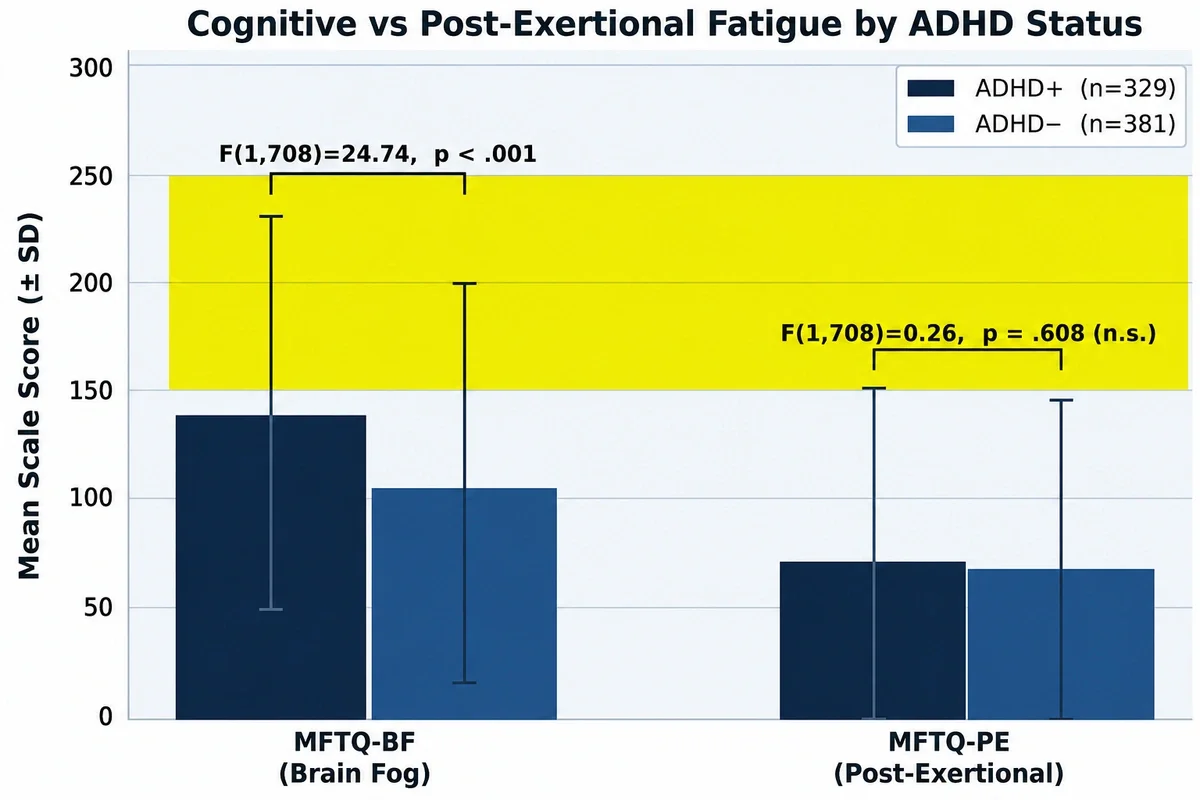
One-way ANOVAs showed a significant difference in average MFTQ-BF score depending on ADHD diagnosis status (F (1) = 24.74, p < 0.001).
Patients with/without ADHD did not have different MFTQ-PE scores (F (1) = 0.263, p = .608).
These findings suggest that ADHD is associated specifically with cognitive fatigue rather than physical fatigue.
Sample Characteristics
The sample was representative of a large range of ages, was fairly balanced by gender, and included multiple races.
N = 2,082
- Scaled Regression n = 856
- ANOVA n = 2,082 (ADHD = 381)
Age
- 35.7 ± 13.6 years
- (consistent with broader RCBM sample)
Sex
- 59.7% female
Race
- 89.6% White
- 3.8% Black
- 3.7% Asian
- 4.0% Hispanic/Latino
Demographics representative of broader age, ADHD, and MindMetrix sample.
Conclusions and Limitations
These results demonstrate a relationship between ADHD symptom severity and cognitive fatigue, distinct from effects of depression, anxiety, and insomnia on fatigue symptoms.
Patients with ADHD reported greater levels of cognitive, but not physical, fatigue, suggesting a link between cognitive load and downstream psychiatric consequences.
Future studies will be necessary to define potential psychological mechanisms and determining causality or bidirectionality of this relationship.
These results may inform individualized treatment approaches for ADHD and ME/CFS and increase awareness of these co-occurring conditions.
Funding
This study was funded by MindMetrix, LLC.
Abbreviations
ADHD, attention deficit hyperactivity disorder; CFS, cognitive fatigue syndrome; Myalgic Encephalomyelitis/CFS Fatigue Types Questionnaire Brain Fog (MFTQ-BF); Myalgic Encephalomyelitis/CFS Fatigue Types Questionnaire Post-Exertional Fatigue (MFTQ-PE).
Disclosures
JLY is the Co-Founder & Chief Medical Officer of MindMetrix and has received grant and research support for research from Axsome Therapeutics, Collegium Pharmaceutical, Janssen Pharmaceuticals, Jazz Pharmaceuticals, Lumos Pharma, Supernus Pharmaceuticals, and Tris Pharma and served on a speakers bureau/advisory board for Axsome Therapeutics, Corium Pharma, Ironshore Pharmaceuticals, Janssen Pharmaceuticals, Noven Pharmaceuticals, Otsuka Pharmaceuticals, Supernus Pharmaceuticals, and Tris Pharma.
MN is the Co-Founder & Chief Executive Officer of MindMetrix.
JS is the Co-Founder & Chief Operating Officer of MindMetrix.
ZL is the Chief Technology Officer of MindMetrix.
JF is the Director of Test Development of MindMetrix
References
- Ali SA, Kheirabadi D. (2025). In: StatPearls [Internet]. Treasure Island (FL): StatPearls Publishing.
- Chen R et al. J Int Med Res. 2008;36(5):867-874.
- Rogers DC et al. British Journal of Clinical Psychology. 2017;56(1):33-52.
- Kessler RC, et al. Am J Psychiatry. 2006;163(4):716-723.
Ready to boost your practice?
Try 3 complimentary assessments on us.