Patients Who Understand Their Care Stay in Care: How Freedom BHS Raised Retention 20%
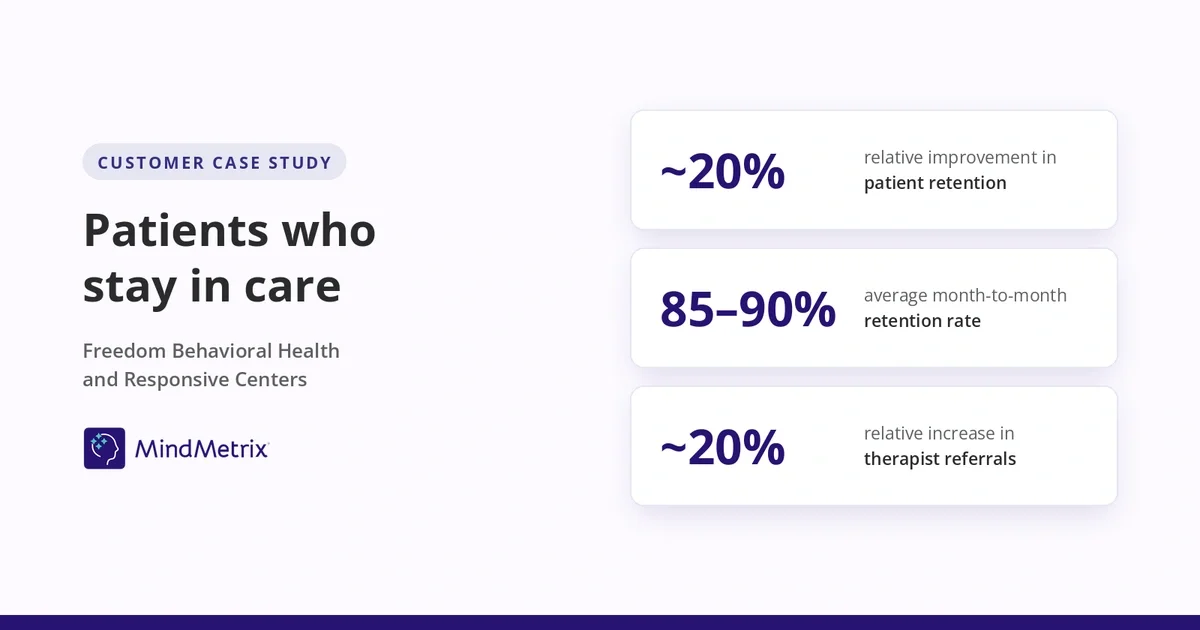
Freedom Behavioral Health and Responsive Centers, a Freedom BHS company, made MindMetrix part of the initial evaluation across their clinics. Since then, Responsive Centers reports roughly a 20% relative improvement in patient retention, month-to-month retention averaging 85–90%, and about 20% more referrals from internal and outside therapists.

“The longer-term value has come from patient retention. Patients have a better understanding of what we are treating, which builds trust in their provider and gives them a reason to continue care with the clinic.”
Curtis Yonke
Chief Executive Officer, Freedom Behavioral Health Solutions and Responsive Centers
THE BIGGEST WIN
Patients who understand their care stay in care
The most important long-term result has been patient retention. When patients finally understand what they are being treated for, and why they may be experiencing certain symptoms, they trust their provider more and have a reason to keep coming back.
At Responsive Centers, that shows up in the numbers. Patients are scheduling more follow-up appointments to learn what their results revealed, and retention has climbed by roughly 20% relative to before MindMetrix.

“We’ve seen an increase in scheduled follow-up appointments, as patients are interested in learning more about what their screenings revealed. Since implementing MindMetrix, we’ve seen approximately a 20% relative improvement in patient retention, with our month-to-month retention rate now averaging around 85–90%.”
Dr. Saha
Chief Medical Officer, Responsive Centers
The assessments themselves bring in immediate revenue, but the larger value has come from patients who stay engaged in care with the clinic.
THE ORGANIZATIONS
Two community practices built around personalized care
Freedom Behavioral Health Solutions provides therapy, counseling, and psychiatric care for individuals, families, military members, and veterans, with both in-person and telehealth visits. Alongside therapy and medication management, Freedom offers advanced options for treatment-resistant depression, including Spravato (esketamine) and Deep TMS, as well as clinician-guided VR therapy.
Responsive Centers, a Freedom BHS company, offers counseling, medication management, psychological assessments, Spravato, and Deep TMS. It recently opened Responsive Centers for Kids, dedicated to children and adolescents ages 6–18. Both organizations are led by CEO Curtis Yonke.
THE CHALLENGE
When screening tools only tell part of the story
Common patient questionnaires and screening tools are valuable, but used in isolation they have limits. In rural communities, where comprehensive testing is scarce, providers often had little else to draw on when diagnostic questions came up.
At the same time, more patients were arriving having researched their own symptoms, sometimes concerned about a specific diagnosis, and sometimes after feeling those concerns had been dismissed elsewhere. Providers needed a way to evaluate those concerns thoroughly. Patients needed a clearer understanding of what they were actually being treated for.
THE SOLUTION
An objective layer of clinical information, at every location
MindMetrix came to Freedom through Responsive Centers. Dr. Saha had already seen its value with his own patients, and when the organizations came together, he introduced it to the Freedom team. Between that clinical benefit and the additional revenue that assessments could bring, Freedom chose to implement MindMetrix across all seven of its sites, and the rollout required no configuration.
MindMetrix gives providers objective data to use alongside their clinical judgment. Being able to support one diagnosis while ruling out another gives them a clearer clinical picture and a more informed basis for treatment decisions.
“MindMetrix provides an additional layer of objective clinical information, allowing our providers to take a more thorough and informed approach to diagnostic clarification and treatment planning.”
Curtis Yonke
Chief Executive Officer, Freedom Behavioral Health Solutions and Responsive Centers
FOR CLINICIANS
Confidence that spreads across the care team
Provider feedback has centered on confidence: in supporting a diagnosis, and in talking through treatment options with patients.
Adoption has also grown beyond prescribers. Therapy staff increasingly ask medication management providers to order MindMetrix testing for their patients, a sign that the results are useful across the whole care team.
Across the clinics, utilization keeps growing, with more providers building MindMetrix into their initial evaluations when establishing care with new patients.
THE PATIENT EXPERIENCE
Patients who feel heard keep showing up
After MindMetrix testing, both organizations have seen stronger trust and rapport between providers and patients. On numerous occasions, patients have thanked their providers for helping them understand their diagnoses and why they may be experiencing certain symptoms.
For patients who arrive with a diagnosis already in mind, providers never rely on results in isolation. But MindMetrix opens the door to a fuller, more informed conversation. Whichever way the results point, patients leave knowing their concerns were taken seriously.
That trust is showing up in attendance, too. At Responsive Centers for Kids, the provider has seen no-show rates drop since implementing MindMetrix. She attributes this in part to patients and families having greater confidence in her clinical decisions and treatment recommendations, especially when they see the time and effort taken to thoroughly evaluate their concerns.
“Whether the results support or challenge what the patient initially believed, the process can provide a sense of relief and validation that their concerns were heard and meaningfully evaluated.”
Curtis Yonke
Chief Executive Officer, Freedom Behavioral Health Solutions and Responsive Centers
THE RESULT
From new tool to standard practice
As awareness of MindMetrix has grown, providers introduce it early in care and use the results to clarify diagnostic questions and build a more focused treatment plan from the start. Financially, assessments bring in immediate revenue, while the larger, longer-term value comes from retention, referrals, and patients who stay engaged in care.
“When patients see that their provider is taking the time to better understand their symptoms and establish an accurate diagnosis, it builds confidence which translates to higher retention, increased referrals, and improved patient compliance.”
Dr. Saha
Chief Medical Officer, Responsive Centers
ADVICE FOR PEERS
Value for providers, patients, and the practice
For other behavioral health practices, the leadership team points to three things: a stronger therapeutic relationship, providers who are more confident in their diagnostic and treatment decisions, and patients who feel reassured that their concerns were thoroughly evaluated. On the business side, that has meant short-term revenue through testing and measurable long-term gains in retention and referrals.
“As a clinic, MindMetrix has allowed us to improve the quality of care we provide, strengthen the therapeutic alliance between providers and patients, and build greater confidence among our providers. More importantly, it gives patients a clearer understanding of their mental health and greater confidence in the treatment they are receiving by helping them answer the question we hear all too often: ‘What am I even diagnosed with?’”
Curtis Yonke
Chief Executive Officer, Freedom Behavioral Health Solutions and Responsive Centers
See what MindMetrix can do for your practice
Whether you run a single clinic or a growing network, MindMetrix helps providers diagnose with confidence and helps patients understand their care.
Talk to Our TeamReady to boost your practice?
Try 3 complimentary assessments on us.